
How much omega-3 does your dog actually need.
Omega-3 fatty acids are among the most useful nutritional supplements you can give your dog. Dose matters. Giving "some fish oil" is not the same as providing an effective amount of omega-3.
The two omega-3 fatty acids that matter most are EPA (eicosapentaenoic acid) and DHA (docosahexaenoic acid). These are the active marine omega-3s linked to healthy skin, joints, cardiovascular function, kidneys, brain health and a balanced inflammatory response.
Omega-3 needs depend on what you are trying to achieve.
A healthy dog on omega-3 for everyday maintenance does not need the same amount as a dog needing targeted nutritional support. Published veterinary nutrition figures use roughly the following amounts of combined EPA plus DHA per kilogram of body weight per day.
| Nutritional goal | EPA + DHA per kg/day |
|---|---|
| Skin support (atopy) | ~60 mg/kg |
| Kidney support | ~66 mg/kg |
| Cardiovascular support | ~55 mg/kg |
| Joint support (osteoarthritis) | ~148 mg/kg |
| Inflammatory bowel support | ~60 mg/kg |
| High triglycerides | ~57 mg/kg |
The key words are EPA plus DHA. Many supplements advertise total "fish oil" or even "total omega-3", but those numbers do not tell you how much active EPA and DHA your dog receives. For the difference between the two, read EPA vs DHA.
These figures are educational reference ranges drawn from veterinary nutrition literature. They are dietary intake references, not treatment doses. Set any higher targeted amount with your vet for your individual dog.
How OmegaMax™ compares.
OmegaMax™ is a concentrated marine omega-3 oil made from purified wild-caught cold-water fish, including sardines, anchovies and mackerel. Each 2 ml pump provides at least 324 mg EPA and 214 mg DHA, giving your pet 538 mg of combined EPA plus DHA per pump.
Each pump also provides a minimum of 624 mg total omega-3 fatty acids and contains natural mixed tocopherols (vitamin E) to help protect these delicate fatty acids from oxidation.
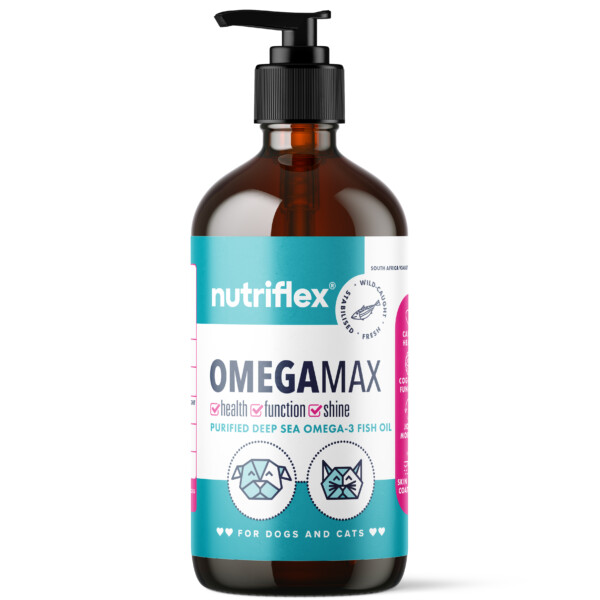
OmegaMax™ 250 ml liquid
538 mg EPA + DHA per 2 ml pump. Wild-caught marine oil, purified in Iceland.
R395 R465
What that means in practice.
For a 10 kg dog, approximate research-based EPA plus DHA targets work out as follows.
| Nutritional goal | Target/day | OmegaMax™ |
|---|---|---|
| Skin support (atopy) | ~600 mg | ~1.1 pumps |
| Inflammatory bowel support | ~600 mg | ~1.1 pumps |
| Cardiovascular support | ~550 mg | ~1 pump |
| Kidney support | ~660 mg | ~1.2 pumps |
| High triglycerides | ~570 mg | ~1.1 pumps |
| Joint support (advanced) | ~1,480 mg | ~2.75 pumps |
The right dose depends on the goal.
OmegaMax™ works at a lower daily level for general maintenance and long-term nutritional support. Higher EPA plus DHA intakes suit specific joint or skin goals. For everyday maintenance, dose by body weight.
| Pet weight | 250 ml liquid | Softgels |
|---|---|---|
| Dogs & cats up to 10 kg | ½ pump daily | 1 softgel |
| Dogs 11 to 20 kg | 1 pump daily | 2 softgels |
| Dogs 21 to 45 kg | 2 pumps daily | 3 softgels |
| Dogs over 45 kg | 3 pumps daily | 4 softgels |
For pets needing more intensive joint support, higher targeted amounts follow body weight and individual needs. Work yours out in the dosing calculator.
Why EPA and DHA matter.
Inflammation is not always bad. It is part of the body's normal repair and immune response. The problem is persistent, poorly regulated inflammation. Modern pet diets often carry far more omega-6 than marine omega-3. EPA and DHA give the body the building blocks it uses to regulate inflammatory signalling.
Adequate marine omega-3 is useful for dogs showing:
- Persistent itching and scratching
- Dry or flaky skin
- Excessive shedding
- Dull coat
- Joint stiffness and reduced mobility
- Age-related cognitive changes
Omega-3 also supports the heart, brain, eyes, skin and coat throughout life.
Why not just use flaxseed or chia.
There is a real difference between plant and marine omega-3. Flaxseed and chia mainly provide ALA (alpha-linolenic acid). Before the body uses ALA the way it uses marine omega-3, it must convert it into EPA and then DHA. Dogs do this inefficiently, and cats even less so. OmegaMax™ supplies preformed EPA and DHA directly, so the body does not rely on that inefficient conversion. Read the full comparison in fish oil vs flaxseed and chia.
Not all fish oils are equal.
When comparing omega-3 supplements, ignore the large number printed next to "fish oil". Look for four things instead.
- How much EPA does it contain?
- How much DHA does it contain?
- Is the oil purified and protected against oxidation?
- Does the maker disclose exactly what you are giving?
OmegaMax™ declares its EPA and DHA from purified marine fish oil, and stabilises it with natural mixed tocopherols (vitamin E). This matters because omega-3 fatty acids are vulnerable to oxidation. Once an oil turns rancid, its nutritional quality drops.
One pump, a measurable amount.
With OmegaMax™ you know exactly what you are giving in every 2 ml pump: at least 324 mg EPA, 214 mg DHA, 538 mg combined EPA plus DHA, and a minimum of 624 mg total omega-3. That lets you dose omega-3 on your pet's actual needs, rather than guessing from the amount of oil in a capsule or spoon.
Work out your pet's exact dose
Enter your dog or cat's weight and goal. We turn these EPA and DHA figures into a simple daily pump amount, supply length and cost per day.
Open the dosing calculatorThe bottom line.
Omega-3 supplementation is not simply about adding oil to your dog's food. The effective dose is set by the amount of EPA plus DHA your dog actually receives. For general health, a daily maintenance amount supports skin, coat, joints, heart and brain through life. Where more targeted support is needed, the amount of EPA plus DHA may need to be considerably higher. OmegaMax™ makes that easy to measure, with 538 mg of combined EPA plus DHA in every 2 ml pump, from purified wild-caught marine fish, protected with natural vitamin E.
This is a nutritional product and is not intended as a substitute for veterinary products or advice. The intake figures above are educational references from veterinary nutrition literature, not treatment doses. Speak to your vet before starting higher targeted amounts, or for any pet with an existing health condition.