
Fish oil vs salmon oil: which is more effective.

Written by Team NutriFlex® · Reviewed by Sharon Milani, Co-founder and Product Development Director, SmartPack PTY Ltd · Published 21 July 2026 · Last updated 24 July 2026
Salmon oil is one of the most popular omega-3 supplements for dogs and cats and it does supply omega-3. The catch is that the words on the front of the bottle tell you very little. What decides the result is how much EPA and DHA your pet actually receives and how clean the oil is. Judged on both, a concentrated small-fish marine oil like OmegaMax™ has a clear edge over most salmon oil.
It is the EPA and DHA that matter, not the label name.
The active marine omega-3s are EPA and DHA. Salmon oil, anchovy oil and sardine oil are simply sources. What reaches your pet and does the work, is the amount of EPA and DHA per dose. So the fair comparison is not salmon against anchovy, it is the declared EPA and DHA in one bottle against the other. For the detail on what each fatty acid does, read EPA vs DHA.
Why salmon oil often falls short on concentration.
Salmon oil is usually lower in EPA and DHA than oil from small pelagic fish such as anchovy and sardine. Many salmon oils also fail to state the EPA and DHA per serving at all, listing only "salmon oil" or a single total omega-3 figure. That leaves you with two problems. You often need a much larger daily dose to reach an effective amount and you cannot tell how much you are actually giving.
OmegaMax™ takes the guesswork out. Every 2 ml pump declares at least 324 mg EPA and 214 mg DHA, which is 538 mg of the two combined. You can see exactly what your pet gets and dose it to their weight. Work it out in the dosing calculator.
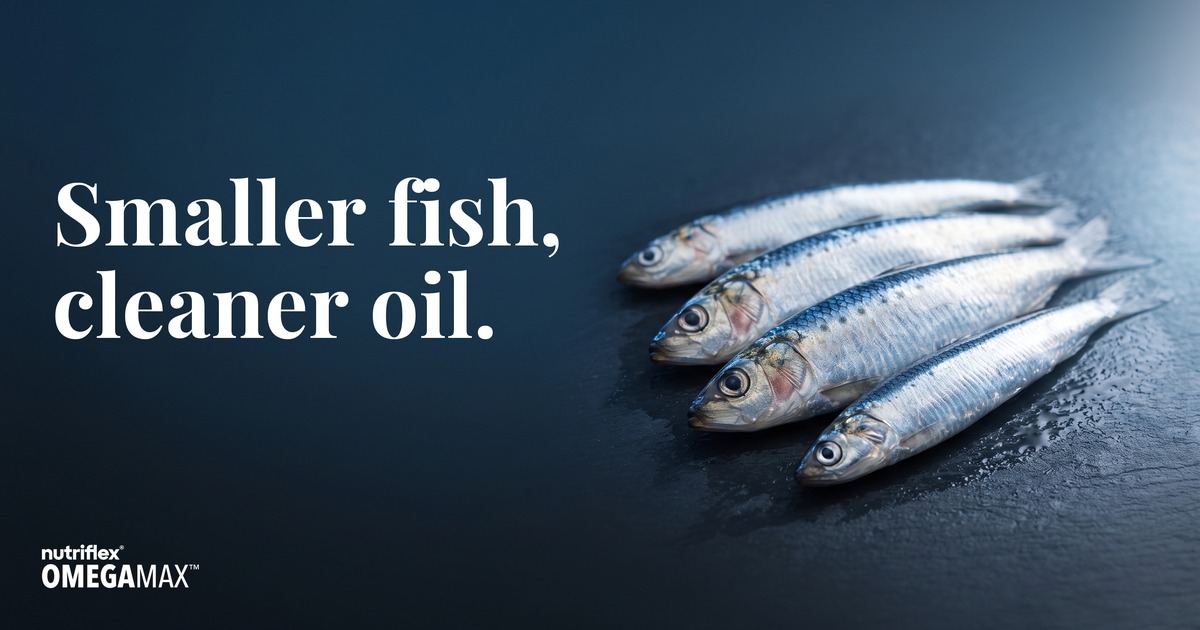
Cleaner by source: smaller fish, lower on the food chain.
Contaminants such as mercury and other pollutants build up as you move up the food chain. A 2025 systematic review by Fioravanti and colleagues in the journal Foods traced that bioaccumulation and biomagnification along the European seafood chain. Small, short-lived fish. Salmon sit higher up and live longer and farmed salmon quality varies, so a salmon-derived oil can carry a heavier contaminant load unless it is carefully purified.
OmegaMax™ starts from the cleaner end of the chain. The oil comes from wild-caught anchovy, sardine and mackerel and it is purified in Iceland to rigorous European purity standards. It is made with Friend of the Sea certified fish oil. Cleaner source, cleaner oil.
The principle. A large fish eats many small fish and keeps what they carried, for years. Start with small fish and there is simply less to remove.
Freshness: the oxidation problem.
Omega-3 oils are fragile. They oxidise, or go rancid, when exposed to air, heat and light. When Albert and colleagues (Scientific Reports, 2015) tested fish oil supplements on sale in New Zealand, most were already highly oxidised and many did not meet their label content for omega-3. Rancid oil loses its nutritional value and smells off, which is often why a pet turns its nose up. Cheaper oils frequently reach the shelf already oxidising.
OmegaMax™ is stabilised with natural mixed tocopherols, a natural form of vitamin E, to protect the oil. The metered pump keeps each dose measured and the bottle sealed between uses, so the oil stays fresher for longer.
Salmon oil vs OmegaMax™ at a glance.
| What to check | Typical salmon oil | OmegaMax™ |
|---|---|---|
| Source fish | Salmon, often farmed, higher on the food chain | Wild-caught anchovy, sardine, mackerel, low on the food chain |
| EPA and DHA per dose | Often lower, sometimes undisclosed | At least 324 mg EPA and 214 mg DHA per 2 ml pump, declared |
| Dose to reach a target | Often larger | Small, measured pump |
| Purity | Varies with source and processing | Purified in Iceland, European purity standards, Friend of the Sea certified oil |
| Oxidation protection | Varies | Natural vitamin E (mixed tocopherols) |
| Suitable for | Dogs and cats | Dogs and cats from 8 weeks |
So is salmon oil bad for dogs and cats.
No. Salmon oil supplies omega-3 and a good salmon oil can help your pet. The point is not that salmon is bad, it is that the name of the fish is not a guarantee of what is inside. If you do use salmon oil, check two things: the declared EPA and DHA per serving and how the oil is purified and protected from oxidation. If a bottle hides its EPA and DHA figures, treat that as a reason to look elsewhere.
How OmegaMax™ compares.
OmegaMax™ is built to remove the guesswork. It is a concentrated marine oil with declared EPA and DHA, from small wild-caught fish, purified in Iceland and stabilised with vitamin E. You dose by weight and know exactly what your pet receives, from a cleaner source, in a smaller amount.
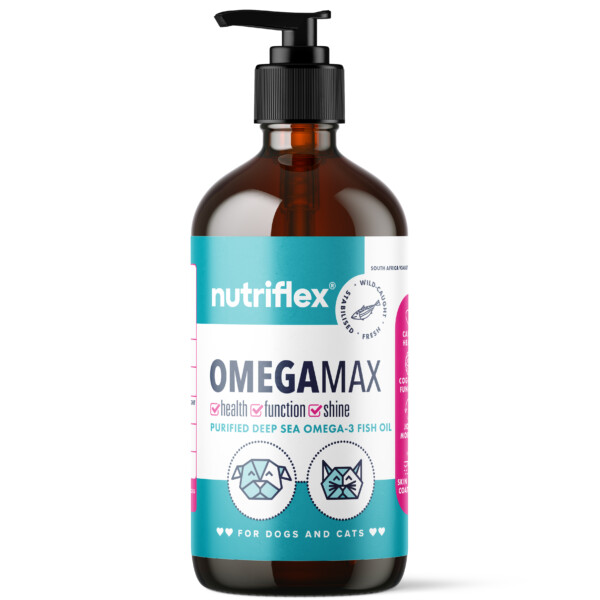
OmegaMax™ 250 ml liquid
538 mg combined EPA and DHA in every 2 ml pump. Wild-caught marine oil, purified in Iceland.
R395 R465
The bottom line.
Salmon oil and OmegaMax™ are both omega-3, but effectiveness comes down to the EPA and DHA delivered and quality comes down to the source and how the oil is purified. A concentrated small-fish oil gives you more usable omega-3 per dose, from fish that carry less to begin with, protected against oxidation. That is why OmegaMax™ is the cleaner, more effective choice for dogs and cats.
Not sure how much your pet needs? Use the dosing calculator, or read how much omega-3 your dog needs.
This is a nutritional product and is not intended as a substitute for veterinary products or advice. Comparisons refer to salmon oil as a category, not to any specific product. Speak to your vet before starting higher targeted amounts, or for any pet with an existing health condition.
Vets2Pets omega-3 vs OmegaMax™ breakdown