
Fish oil vs flaxseed and chia: why plant omega-3 falls short.

Written by Team NutriFlex® · Reviewed by Sharon Milani, Co-founder and Product Development Director, SmartPack PTY Ltd · Published 21 July 2026 · Last updated 27 July 2026
Flaxseed oil and chia sit on plenty of shelves marketed as omega-3 for pets. They do contain omega-3, so the label is not wrong. The problem is the type of omega-3 they carry and what your dog or cat can actually do with it. Plant sources and marine sources are not interchangeable, and for pets the gap between them is wide.
Not all omega-3 is the same molecule.
Omega-3 is a family, not a single nutrient. The three that matter for animals are ALA, EPA and DHA.
- ALA (alpha-linolenic acid) is a short-chain omega-3 found in plants. Flaxseed, chia, hemp and canola are the common sources.
- EPA (eicosapentaenoic acid) is a long-chain omega-3 found in marine sources. It supports a normal, balanced inflammatory response.
- DHA (docosahexaenoic acid) is a long-chain omega-3 that helps maintain the brain, nervous system and eyes.
Flaxseed and chia give you ALA. Almost none of the working benefit that owners associate with omega-3 comes from ALA directly. That benefit comes from EPA and DHA. If you want to understand how each of the two long-chain forms behaves in the body, read the difference between EPA and DHA.
The conversion problem.
ALA is not useless, but the body has to convert it into EPA and then into DHA before it does the work owners are paying for. That conversion runs through a chain of enzymes, and each step loses a large share of what went in. Dunbar and Bauer (2002) examined the enzyme step that limits this pathway in dogs. It is slow and inefficient even in humans.
In dogs the conversion happens, but at a low rate. Only a small fraction of the ALA in a spoonful of flaxseed oil ever reaches the EPA and DHA your dog actually uses. To land a useful amount of long-chain omega-3, you would have to feed far more ALA than is practical, and much of it still never arrives.
Cats sit at the far end of this. As Burron and colleagues note in their 2024 review in the Journal of Animal Science, cats have a very limited ability to convert ALA into EPA and DHA, because they are obligate carnivores built to get preformed nutrients from animal tissue rather than manufacture them from plants. For a cat, feeding flaxseed or chia does very little. The omega-3 goes in, and almost none of it comes out as the forms the cat can put to use.
Rule of thumb. Plant omega-3 asks your pet's body to do the conversion work. Marine omega-3 has already done it. Cats in particular gain almost nothing from plant sources.
Marine omega-3 skips the conversion entirely.
Fish and the small marine species they feed on carry EPA and DHA in their preformed, ready-to-use state. When you give a marine fish oil, you deliver those two long-chain omega-3s directly. There is no enzyme bottleneck to squeeze through and no reliance on a conversion step that dogs run poorly and cats barely run at all.
That is the whole reason fish oil and plant oil are not equivalent. Both are labelled omega-3, but only one arrives in the form your dog or cat can use straight away.
| Feature | Flaxseed and chia | Marine fish oil |
|---|---|---|
| Main omega-3 supplied | ALA (short-chain) | EPA and DHA (long-chain) |
| Conversion needed | Yes, ALA to EPA to DHA | None, already preformed |
| Works for dogs | Poorly, low conversion | Yes, direct |
| Works for cats | Very little, minimal conversion | Yes, direct |
What this means when you read a label.
Seeing "omega-3" or "rich in omega-3" on a pet product tells you almost nothing on its own. The question to ask is which omega-3, and in what amount.
- If the source is flaxseed, chia, hemp or another plant oil, you are looking at ALA. Assume your dog converts little of it and your cat almost none.
- If the source is fish oil or another marine oil, check the actual milligrams of EPA and DHA, not just the total oil weight. The long-chain numbers are what count.
A large dose of plant oil with a big ALA figure can still deliver less usable omega-3 than a small, honest marine dose. Total omega-3 on the front of the pack is not the same as usable EPA and DHA.
Where OmegaMax™ fits.
OmegaMax™ delivers preformed EPA and DHA from wild-caught anchovy, sardine and mackerel. The oil is purified in Iceland and is made with Friend of the Sea certified fish oil, so you get the long-chain forms your pet can use without asking the body to convert anything.
Each 2ml pump supplies at least 324 mg EPA, 214 mg DHA and 538 mg of the two combined. It suits dogs and cats from eight weeks of age, which matters for cats especially, since a marine oil is one of the few practical ways to get real EPA and DHA into an animal that cannot make them from plants.
Amounts still need matching to your pet's weight. To work out a sensible daily dose, use the dosing calculator, which turns the per-pump figures above into a plan for your specific animal.
The short version.
Flaxseed and chia give ALA, a short-chain omega-3 that your pet has to convert. Dogs manage this weakly and cats hardly at all, so plant oils fall short of what most owners think they are buying. Marine fish oil supplies EPA and DHA in the ready form, which is why it does the job plant sources cannot.
For the full picture on daily amounts and why the long-chain forms matter across life stages, read how much omega-3 your dog needs, or run the numbers now in the dosing calculator.
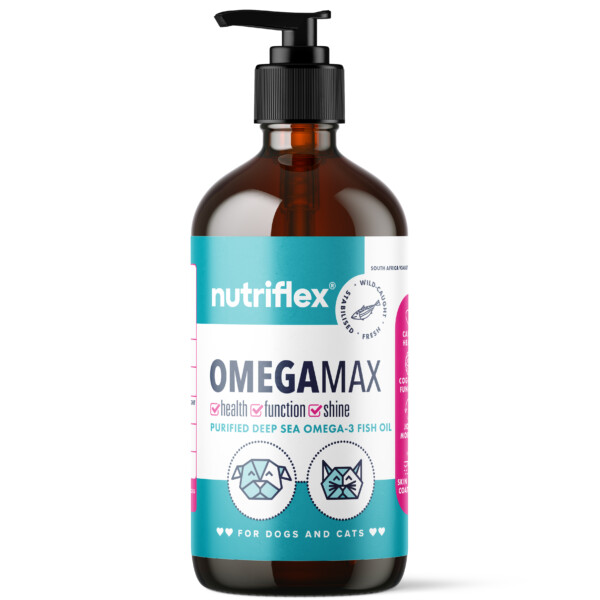
OmegaMax™ 250 ml liquid
538 mg combined EPA and DHA in every 2 ml pump. Wild-caught marine oil, purified in Iceland.
R395 R465
This is a nutritional product and is not intended as a substitute for veterinary products or advice. Speak to your vet before starting higher targeted amounts, or for any pet with an existing health condition.