
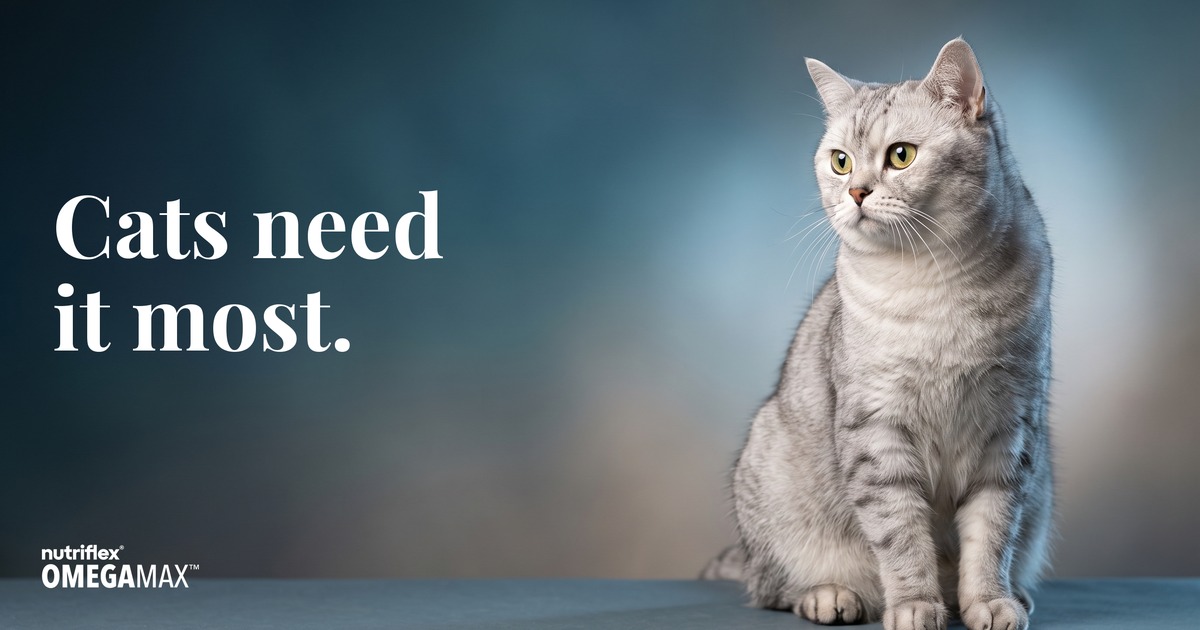
Omega-3 for cats: is fish oil safe and how much?

Written by Team NutriFlex® · Reviewed by Sharon Milani, Co-founder and Product Development Director, SmartPack PTY Ltd · Published 21 July 2026 · Last updated 24 July 2026
Fish oil is safe for cats when you dose it correctly and introduce it slowly. Cats have a specific need for marine omega-3, and getting the amount right matters more for them than for many dog owners realise. This guide covers why cats need preformed EPA and DHA, how much your cat needs, and how to add it to food without a fuss.
Is fish oil safe for cats.
Yes. A quality marine fish oil is safe for healthy cats when you give a sensible daily amount and build up gradually. The two things to watch are the dose and the introduction. Too much too soon can upset a sensitive stomach, and cats are cautious about new smells and tastes on their food.
Start small. Give a fraction of the target amount for the first few days, then work up to the full daily dose over roughly a week. This gives your cat time to accept the taste and lets you check that everything settles well.
OmegaMax™ is suitable for cats and dogs from 8 weeks of age. The liquid is low in odour, which helps with fussy cats, and you pump it straight onto wet or dry food.
Why cats need marine omega-3 specifically.
Omega-3 comes in two broad forms. Plant sources like flaxseed and chia give you ALA. Marine sources like fish oil give you the preformed EPA and DHA that the body actually uses. To benefit from a plant source, an animal has to convert ALA into EPA and DHA inside the body.
Cats convert ALA very poorly. Burron and colleagues (Journal of Animal Science, 2024) describe the enzyme capacity behind that conversion as limited or effectively absent in cats, so plant omega-3 does little for them. This is why preformed marine EPA and DHA matter more for cats than they do for dogs. If you want the fatty acids to reach your cat, they need to arrive ready to use. You can read more on why plant omega-3 falls short if you are weighing up your options.
The short version. A spoon of flaxseed oil on your cat's dinner is not a substitute for fish oil. Cats need the EPA and DHA that only marine oil delivers directly.
What EPA and DHA support in cats.
EPA and DHA are structural and functional fats that the body uses across several systems. In cats, marine omega-3 supports:
- Skin and coat. Helps maintain a soft coat and healthy skin condition.
- Joints. Supports comfortable movement, which matters for older and less active cats.
- Heart. Supports normal heart function as part of a balanced diet.
- Brain. DHA supports normal brain function across life stages.
These are everyday nutritional benefits. Omega-3 is a nutritional product, not a treatment, and it works best as a steady daily habit rather than an occasional top-up.
How much fish oil does your cat need.
The OmegaMax™ 250ml liquid uses a metered pump so the amount stays consistent. For cats, a small daily dose does the job.
| Cat weight | Daily amount | Approx EPA | Approx DHA |
|---|---|---|---|
| Up to 10kg | Half a pump (1ml) | About 162 mg | About 107 mg |
A full 2ml pump delivers at least 324 mg EPA, 214 mg DHA and 538 mg of the two combined. A half pump gives your cat roughly 162 mg EPA and 107 mg DHA daily, which suits most cats up to 10kg for maintenance.
At half a pump a day, a single 250ml bottle lasts around 250 days. That works out to about R1.58 a day, so a year of daily omega-3 stays affordable for one cat.
If you have a cat with an existing health condition, or your cat is on medication, check with your vet before you start. Your vet may want to adjust the amount for your cat's needs.
How to add it to your cat's food.
Keep it simple.
- Pump the oil straight onto your cat's usual wet or dry food.
- Start with less than the target amount for the first few days.
- Build up to the full daily dose over about a week so your cat gets used to the taste.
- Feed it at the same meal each day to keep the routine steady.
- Refrigerate the bottle after opening to keep the oil fresh.
The low odour helps here. Strong-smelling oils put cats off, while a cleaner smell makes acceptance easier. If your cat hesitates at first, drop back to a smaller amount and try again the next day.
Where OmegaMax™ comes from.
The oil is purified in Iceland from wild-caught anchovy, sardine and mackerel. It is made with Friend of the Sea certified fish oil, so the fish come from responsibly managed sources. The result is a clean marine oil that gives your cat the preformed EPA and DHA their body cannot make in useful amounts from plants.
Cats and dogs in the same home.
If you keep both, the same bottle works across the household. Dogs need more per kilogram than cats and dose by body weight, so the amounts differ. For the dog side of things, see the full dosing guide and match each pet to its own weight.
Not sure of the exact amount for your cat's weight, or working out a shared bottle for several pets? Use the dosing calculator to set the daily amount in seconds, then start small and build up over the first week. This is a nutritional product and not a substitute for veterinary advice, so speak to your vet about any cat with an existing health condition.
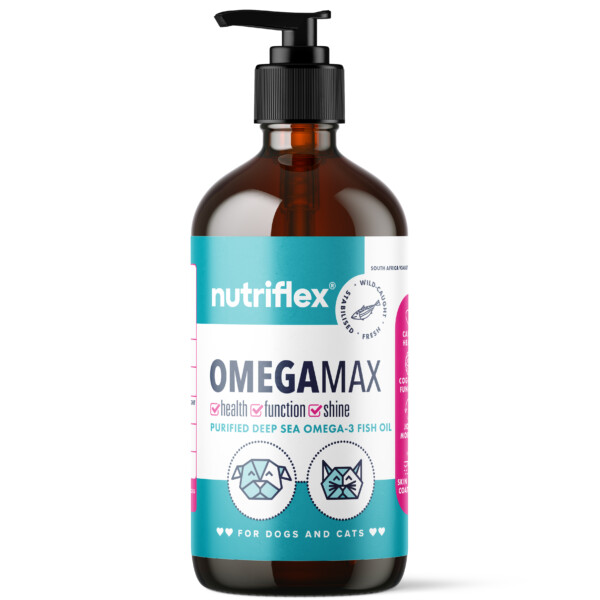
OmegaMax™ 250 ml liquid
538 mg combined EPA and DHA in every 2 ml pump. Wild-caught marine oil, purified in Iceland.
R395 R465
This is a nutritional product and is not intended as a substitute for veterinary products or advice. Speak to your vet before starting higher targeted amounts, or for any pet with an existing health condition.