
EPA vs DHA: the two omega-3s that matter.

Written by Team NutriFlex® · Reviewed by Sharon Milani, Co-founder and Product Development Director, SmartPack PTY Ltd · Published 21 July 2026 · Last updated 24 July 2026
Not all omega-3s are equal. When you read a fish oil label, two names carry almost all of the value for your dog or cat. They are EPA and DHA. These are the long-chain marine omega-3s that your pet's body can actually put to work. This guide explains what each one does, why the source matters, and how much OmegaMax™ delivers in a single pump.
What EPA and DHA actually are.
EPA stands for eicosapentaenoic acid. DHA stands for docosahexaenoic acid. Both are long-chain omega-3 fatty acids, and both come from marine sources such as oily fish. They sit at the end of a chain of conversions that starts with a shorter plant omega-3 called ALA. The problem is that dogs and cats convert ALA into EPA and DHA very poorly. In their 2024 review of omega-6 and omega-3 balance in the Journal of Animal Science, Burron and colleagues describe that conversion capacity as limited in dogs and effectively negligible in cats. This is why the finished forms, EPA and DHA, matter so much.
When you feed marine oil, you skip the conversion step. Your pet receives EPA and DHA ready to use. That is the core reason marine sources beat plant sources for these two fatty acids, and it is covered in more detail in our piece on fish oil versus flaxseed.
What EPA does.
Think of EPA as the calm-and-comfort omega-3. In his review of therapeutic fish-oil use in companion animals, Bauer (JAVMA, 2011) describes EPA as the fatty acid most associated with a balanced inflammatory response. In practical terms, EPA helps support:
- Skin comfort and a settled coat
- Joint mobility and everyday movement
- Cardiovascular function
- A measured, balanced inflammatory response
If your dog scratches through the season, or your older cat is slowing down, EPA is usually the fatty acid you want in good supply. It works quietly in the background to help maintain comfort day to day.
What DHA does.
DHA is structural. It is built into the membranes of cells, and it is concentrated in tissue that has to fire fast and often: the brain, the eyes and the wider nervous system. Zicker and colleagues (JAVMA, 2012) evaluated cognitive learning, memory and retinal function in puppies fed DHA-rich fish oil. DHA helps support:
- Brain function and cognition
- Eye and retinal health
- Nervous-system signalling
DHA carries extra weight at the two ends of life. In puppies and kittens it helps support the developing brain and eyes. In ageing dogs and cats it helps maintain cognitive sharpness as the years add up. A growing pet and a senior pet both benefit from steady DHA, for different reasons.
Simple way to remember it. EPA leans towards comfort, skin, joints and heart. DHA leans towards brain, eyes and nerves. Most pets do best with a strong supply of both, which is why the combined EPA and DHA figure is the number to watch.
Why the label total can mislead you.
Here is the trap. Many products lead with a large "fish oil" or "total omega-3" figure. That number tells you almost nothing on its own. A tin of fish oil can be high in total omega-3 while carrying modest EPA and DHA. The rest is made up of other fatty acids that do far less for your pet.
So read past the headline. Look for the EPA figure and the DHA figure, stated in milligrams, per serving. If a label hides those two numbers, treat that as a reason to look elsewhere. When you know the EPA and DHA per dose, you can work out whether your pet is getting a meaningful amount. Our guide on how much omega-3 your dog needs walks through the maths.
What OmegaMax™ delivers.
OmegaMax™ states its EPA and DHA openly, per dose, so you are never guessing. Here is what you get from each format.
| Per serving | Liquid, 1 pump (2ml) | Softgel (1000mg) |
|---|---|---|
| EPA | At least 324 mg | At least 180 mg |
| DHA | At least 214 mg | At least 120 mg |
| Combined EPA and DHA | 538 mg | 300 mg |
| Total omega-3 | Minimum 624 mg | At least 350 mg |
Notice that the liquid gives you both a high EPA figure and a solid DHA figure in one 2ml pump. That balance is deliberate. It gives you EPA for skin, joints and heart, and DHA for brain, eyes and nerves, in a single daily dose you can scale to your pet's weight.
Where the oil comes from.
Quality of source shapes quality of the finished EPA and DHA. The OmegaMax™ oil is purified in Iceland from wild-caught anchovy, sardine and mackerel. It is made with Friend of the Sea certified fish oil, and it is stabilised with natural mixed tocopherols, a natural form of vitamin E. That vitamin E does two jobs. It helps keep the delicate omega-3s stable in the bottle, and it adds an antioxidant your pet can use.
Small, fast-lived fish sit low on the food chain, which is why they are a sensible starting point for a clean marine oil. Careful purification then concentrates the EPA and DHA and removes what you do not want.
So which one matters more.
The honest answer is that both matter, and the right emphasis depends on your pet. A young, growing puppy or kitten leans on DHA for development. A senior pet leans on DHA for cognition and on EPA for joint comfort. A pet with itchy, seasonal skin leans on EPA. Rather than picking one, aim for a dose that supplies a strong combined figure of both, then adjust the amount to your pet's size.
That is the practical next step. Work out the right daily dose for your dog or cat by weight, then feed it consistently. Use our dosing calculator to turn these EPA and DHA numbers into a simple daily amount, and keep it steady so your pet gets the benefit day after day.
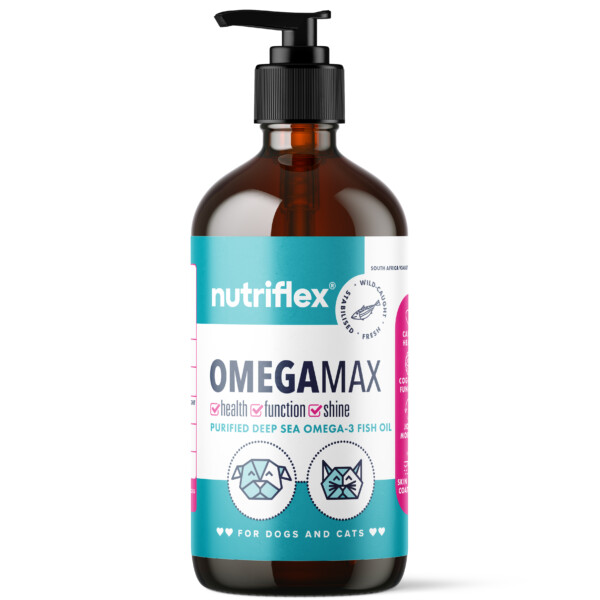
OmegaMax™ 250 ml liquid
538 mg combined EPA and DHA in every 2 ml pump. Wild-caught marine oil, purified in Iceland.
R395 R465
This is a nutritional product and is not intended as a substitute for veterinary products or advice. Speak to your vet before starting higher targeted amounts, or for any pet with an existing health condition.