

Why is my dog so itchy?

Written by Team NutriFlex® · Reviewed by Sharon Milani, Co-founder and Product Development Director, SmartPack PTY Ltd · Published 26 July 2026 · Last updated 27 July 2026
You know the sound. The collar jingling in the dark, the thump of a back leg against the floor, the wet licking that starts the moment the house goes quiet. By morning there is hair on the couch and a patch behind one ear that looks worse than it did yesterday.
Itching is one of the most common reasons South African owners start reading about what is in their dog's bowl. It is also one of the hardest things to sort out, because at least six ordinary causes produce almost the same picture and they overlap. Most owners work through them in the least useful order, spend money on the wrong thing first and end up concluding that nothing helped.
This page gives you an order to work in. It also gives you a straight answer on where food fits.
Start with the obvious causes, in this order.
Before you change anything in the bowl, rule out the three things that account for most itching. They are quicker to check, cheaper to fix and if one of them is the answer, no amount of dietary support will do the job in its place.
1. Parasites, even when you cannot see any.
Fleas are the most common cause of itching in dogs and you will often never see one. A single flea can drive days of scratching. A dog that grooms heavily removes the evidence itself.
So stop hunting for the insect and look for what it leaves behind. Brush the coat over the lower back and the base of the tail onto a damp sheet of white paper towel. Flea dirt is digested blood, so it smears reddish brown. Ordinary dirt stays dark and does not run.
Mites are the other candidate and they behave differently. Intense scratching around the ears, elbows and hocks that comes on over a week or two, in a dog that has been comfortable for years, is worth having looked at properly rather than managed at home.
One note for coastal readers: fleas do not take a Cape winter off. Warm houses keep the life cycle running straight through July.
2. What changed recently.
Itching that starts within days of a change usually points at the change. Run back three or four weeks and write down what is new. A different bag of food. A new treat or chew. A fresh bed. A change of shampoo. A different washing powder on the blankets. A new grooming parlour.
The list matters more than your memory does, because the useful detail is almost always the one nobody thought was worth mentioning.
3. What your dog walks through.
Grass, beach sand, dust on a newly swept floor, cleaning product on tiles that have not finished drying. Contact itching shows up where the dog meets the ground: paws, belly, groin, chin. If the paws are the worst part and the back is fine, look down rather than in the bowl.
The season tells you more than most owners expect.
Almost every owner can tell you their dog is itchy. Very few can tell you when it started. That single piece of information is often the most useful thing you have.
South Africa runs two distinct itch patterns and they sit at opposite ends of the year.
Winter itching is dry itching. Cold air holds less moisture, heaters dry it further, bathing drops off and coats go longer between brushes. The picture is flaky skin, a coat that has lost its gloss and general scratching that is not concentrated anywhere in particular. It looks worst in July and August, which is exactly now.
Spring itching looks different. From September the grass seeds start, the pollen count climbs and in the Cape the wind carries both a long way inland. On the Highveld the gardens dry out and dust joins in. This pattern is more localised, often worse on the belly, paws and face. It tends to arrive within the same two or three weeks every single year.
So write the date down. If your notes say mid-September three years running, you are dealing with something environmental and you can get ahead of it next year instead of reacting to it. If the itching runs all year with no pattern at all, that points somewhere else, which is the next section.
When the itch has no obvious cause.
Some dogs come through everything above clean. Parasite control is current, nothing has changed, the itching does not track the season and it has been going on for months. This is the point at which the skin itself is worth thinking about.
Skin is a barrier before it is anything else. Its job is to hold moisture in and keep everyday irritants out. It is built and repaired continuously out of what your dog eats. When that barrier is doing its job, your dog walks through the same grass as every other dog and nothing comes of it. When it is under strain, ordinary contact starts to register as itch.
Dietary fat is part of what builds it. Dogs need both omega-6 and omega-3 fats and the balance between them matters as much as the amounts. Most dry diets lean heavily towards omega-6 from plant and poultry fats and light on the marine omega-3 that comes from oily fish. Burron and colleagues (Journal of Animal Science, 2024) review how that balance shapes inflammatory signalling in dogs and cats. Skin and coat are usually where an owner notices it first.
That is the short version. For what EPA and DHA actually do, how long they take and how much a dog of your dog's size needs, read omega-3 for dog skin, coat and itching.
A quick self-check.
None of this replaces knowing your own dog. But if you are standing in the kitchen watching him scratch and you are not sure what to do next, find the row that matches what you are actually seeing.
| What you are seeing | What it often points to | Sensible next step |
|---|---|---|
| Scratching, plus black specks in the coat that smear reddish brown | Fleas, even if you never see one | Current parasite control on every pet in the house, plus the bedding and the floors |
| Started within days of something new | Contact, or a recent change | Remove one variable at a time, starting with the most recent |
| Arrives in the same few weeks every year | Seasonal and environmental | Note the dates, then support the skin barrier ahead of the season rather than during it |
| Year-round dry flaky skin and a dull coat, no clear trigger | Long-term strain on the skin barrier | Check what your dog actually gets in EPA and DHA per day |
| Raw, broken, weeping or getting worse quickly | Past the point of home management | See your vet |
Two things this table will not do. It will not diagnose anything, because several causes produce the same picture and more than one can be running in the same dog. And it will not tell you the cause is diet, because most of the time it is not. What it will do is stop you spending three months on the fourth row when the answer was sitting in the first.
Omega-3 supports skin and coat health. It is not a treatment for any skin condition. If your dog has raw, broken, weeping or rapidly worsening skin, see your vet.
Where diet fits, where it does not.
Worth saying plainly on a page published by a company that sells fish oil: food is not the first lever here and it is not the fast one.
Omega-3 will not fix a flea problem. It will not undo an irritant your dog walks through twice a day. If either of those is the cause, changing the bowl while the cause stays where it is buys you nothing except a longer wait.
What dietary support does is different in kind. It works on the baseline underneath everything else, the barrier that decides how much ordinary contact your dog tolerates before it becomes a problem. Mueller and colleagues (Journal of Small Animal Practice, 2004) ran a ten-week course of omega-3 supplementation in dogs and measured the effect on skin. Work of that kind is why omega-3 is discussed for skin at all. It is worth being precise about what it shows. Research shows omega-3 supports skin health. It does not show that any particular bottle will produce a particular result in your dog.
Two practical consequences follow.
It is measured in weeks. Coat changes tend to show up around a month in. Skin comfort comes later than that. Owners who judge it after five days conclude it does nothing. The detail is in how long omega-3 takes to work.
The amount has to be right, because too little does very little. That depends on your dog's weight and it is not a spoonful for everyone. Put the weight into the dosing calculator, or read how much omega-3 your dog needs for the reasoning behind the numbers.
What to do this week.
None of this needs a purchase. It needs about twenty minutes and a note on your phone.
- Check that parasite control is genuinely current, not roughly current, on every animal in the house. Do the paper towel test while you are at it.
- Change one thing at a time. Two changes at once tells you nothing about either.
- Write down the date the itching started and note where on the body it is worst. Next year this note is worth more than anything else you do today.
- Photograph the worst patch once a week, same spot, same light. Skin changes slowly enough that your memory will tell you it is unchanged when the photos say otherwise.
- Keep EPA and DHA steady if you are supplementing. Starting and stopping is the most common reason owners see nothing.
- Judge it after several weeks, not several days.
Common questions.
Can food alone stop my dog itching?
Sometimes, if the food was the cause. Often not, because most itching starts somewhere else. Diet is better understood as the thing that changes how well your dog's skin copes with everything else, rather than as a switch that turns itching off.
Is it still fleas if I cannot see any?
Very possibly. Dogs that scratch and groom heavily remove adult fleas themselves, so absence of fleas is weak evidence. Flea dirt on damp paper towel is much better evidence than a visual search. It also costs nothing to check.
How long before I should expect a change?
For dietary support, think in weeks rather than days. Coat condition tends to move first, skin comfort later. If you have given it a fortnight and concluded it failed, you have not given it long enough to tell.
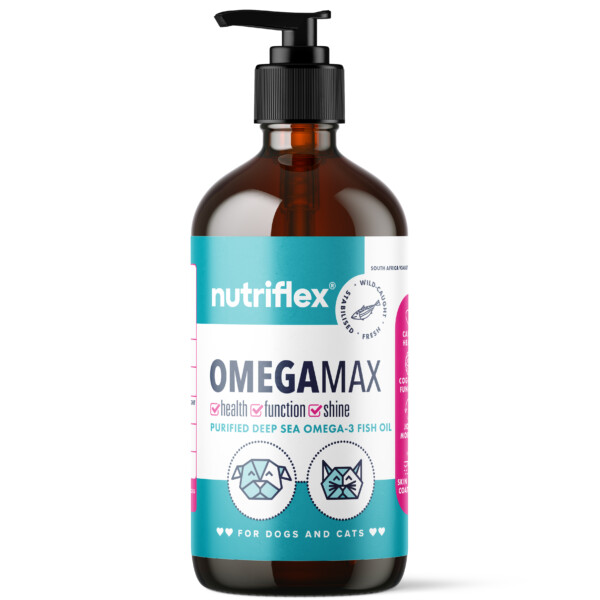
OmegaMax™ 250 ml liquid
538 mg combined EPA and DHA in every 2 ml pump. Wild-caught marine oil, purified in Iceland.
R395 R465
This is a nutritional product and is not intended as a substitute for veterinary products or advice. Speak to your vet before starting higher targeted amounts, or for any pet with an existing health condition.